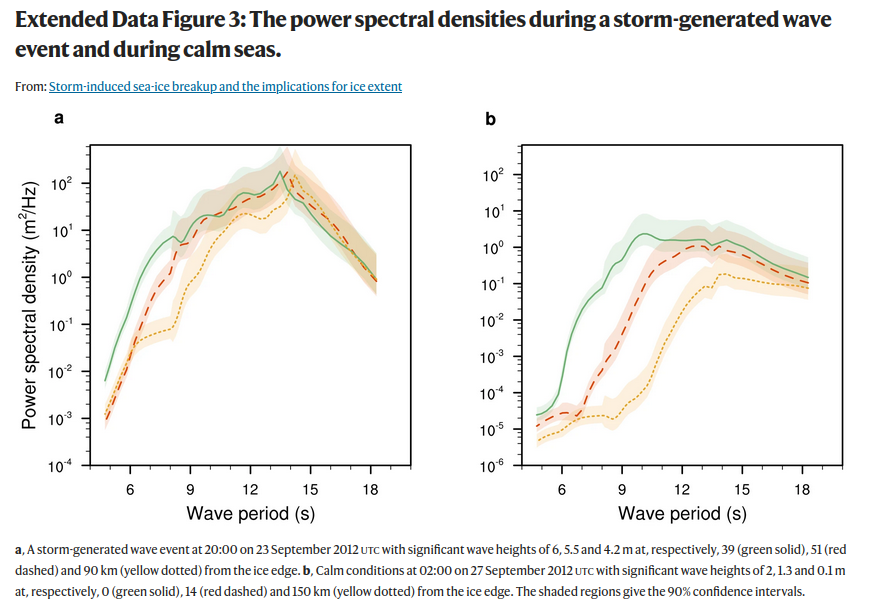
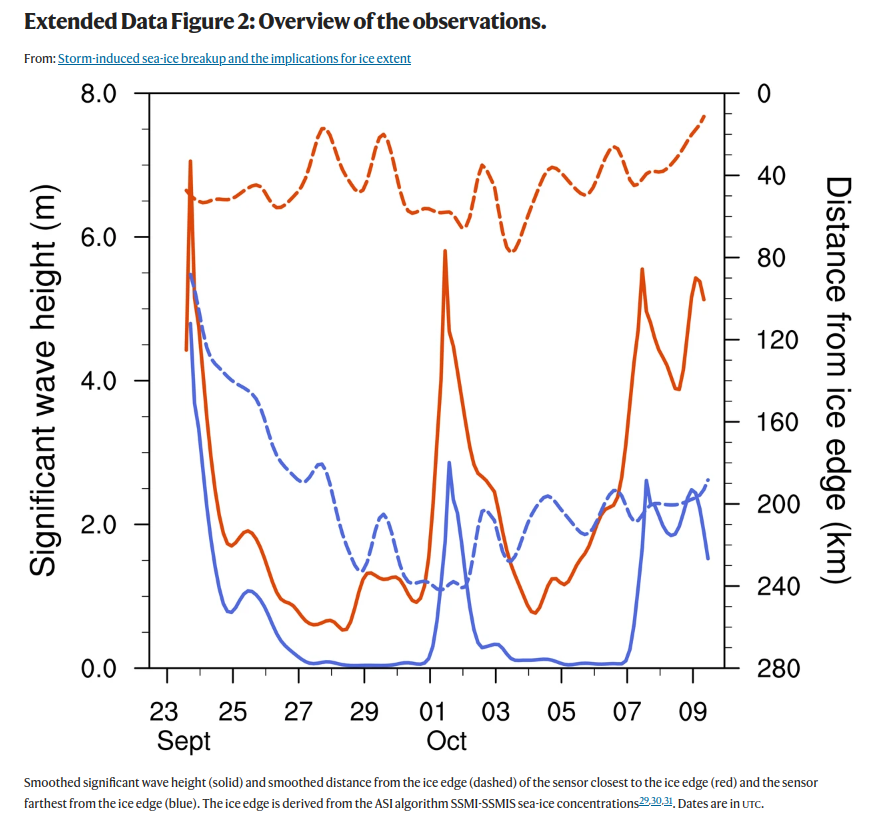
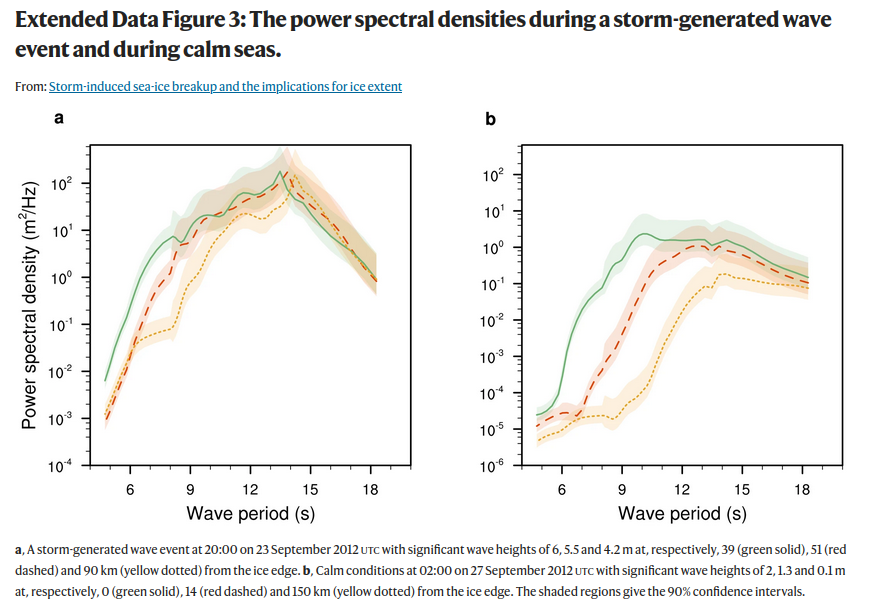
Figure 3 from Kohout *et al.* (2014), [*Storm-induced sea-ice breakup and the implications for ice extent*](publications/), **Nature** 509. WII buoy data showing the relationship between wave height and ice-edge retreat.
Real buoy data, where we can publish it.
Sample data — small examples of decoded buoy output (CSV / JSON),
an Iridium SBD payload schema, and reference plots.
Public archives — historical WII deployment datasets published by
Dr Alison Kohout (NIWA)
on Mendeley. Mirrored as pointer pages below.
Permissions and ownership — who owns the data from each deployment
and what’s open vs restricted. Not every deployment can be published.
Public deployment datasets
These are the publicly released WII observation datasets from Alison
Kohout’s project page. Each links to the canonical Mendeley archive.
SIPEX II — East Antarctic sea ice, 2012. Five WIIOS
units, 268 wave records.
PIPERS — Ross Sea, 2017. Fourteen WIIOS units, 23,000+
wave records during autumn ice growth.
JARE61 — East Antarctica, 2019/20 summer. Additional
WIIOS units with notably longer survival times on seasonal ice.
Publications
Publications — the peer-reviewed papers produced
from these datasets, including the 2014 Nature paper on storm-induced
sea-ice breakup. Mirrors Alison Kohout’s bibliography.
The WIIOS sensor (Waves in Ice Observation System) is the
Alison-Kohout-designed instrument behind these datasets. WII5 is the
current generation of buoy built on the same lineage. See
Software → Onboard Data Processing
for how the on-board maths reduces the data shown in those datasets.
Status: placeholder for sample payloads, schema, and ownership table.
1 - SIPEX II — East Antarctica 2012
SIPEX II — five WIIOS units deployed across East Antarctic sea ice from RV Aurora Australis, 2012.
The second Sea Ice Physics and Ecosystem Experiment (SIPEX II)
deployed five WIIOS units along a meridional transect from the RV
Aurora Australis across East Antarctic sea ice in 2012. The mission
investigated relationships between the physical sea-ice environment,
marine biogeochemistry, and Southern Ocean ecosystem structure.
PIPERS — fourteen WIIOS deployed during autumn sea-ice growth in the Ross Sea, 2017. 23,000+ wave records.
The Polynyas, Ice Production, and seasonal Evolution in the Ross Sea
(PIPERS) campaign deployed fourteen WIIOS units during the autumn
sea-ice growth period in 2017, producing the largest single WII
dataset to date — over 23,000 wave records, two orders of magnitude
beyond SIPEX II.
JARE-61 — WIIOS units deployed during the 61st Japanese Antarctic Research Expedition, East Antarctica summer 2019/20.
The 61st Japanese Antarctic Research Expedition (JARE-61) deployed
additional WIIOS units on East Antarctic sea ice during the 2019/20
summer season. The summer deployment is notable for the WIIOS units
surviving longer than in earlier campaigns despite being placed on
seasonal (rather than multi-year) ice.
Location: East Antarctica
Year/Season: 2019/20 summer
Expedition: JARE-61 (Japanese Antarctic Research Expedition)
No JARE-61 papers are listed in the project bibliography yet — papers may
be in preparation. See the full Publications page
for the broader paper trail and Alison Kohout’s
canonical list
for the latest additions.
Peer-reviewed publications drawing on WII buoy data — including the 2014 Nature paper on storm-induced sea-ice breakup. Mirrors Alison Kohout’s project bibliography.
Peer-reviewed publications produced from WII wave-buoy deployments and the
underlying mathematics. Mirrors the bibliography on
Alison Kohout’s project page —
canonical list is hers; this page is a local pointer so the work shows up
alongside the datasets.
Methodology and theory — the remaining papers above develop the
models and analytical methods used across the deployments
(Kohout & Meylan 2008; Meylan et al. 2014; Li et al. 2015; Toyota et al.
2016; Kohout et al. 2016; Thomson et al. 2021; Montiel et al. 2022;
Brouwer et al. 2022).
Canonical source
This list mirrors and may lag the canonical list at
Alison Kohout — Publications.
Check there for the most recent additions.