Enclosures
Categories:
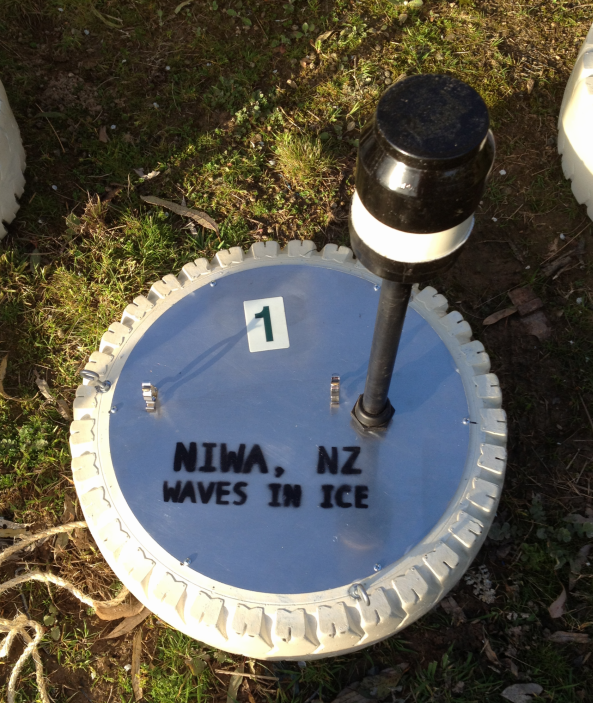
Enclosure designs for WII buoys, from the simplest ice-surface case through fully floating buoys built to survive Antarctic deployment. Choice of enclosure drives almost everything downstream — battery sizing, sensor mounting, what the antenna can see, and how the buoy behaves when the ice moves.
Design decisions
Ice survival
The enclosure has to live on or in sea ice for months. That means surviving freeze-in, freeze-thaw cycles, ice ridging, and the mechanical loads when floes collide. Critical points:
- Sealing under thermal cycling. Gaskets that work at 20 °C can fail below −30 °C. We use materials chosen for low-temperature flexibility and test the full assembly through cold-soak cycles before deployment.
- No external moving parts. Anything that hinges, slides, or rotates will eventually freeze open or shut.
- Drainage and ice expulsion. Water that gets in (and it always does) must be able to leave before it freezes and cracks the housing.
Temperature range
WII buoys deploy from Antarctic winter (−40 °C ambient, colder with wind-chill) through to direct-sun loading on dark surfaces in spring (+30 °C internal). The electronics, battery, and seals all need to span that. Practical consequences:
- Battery chemistry has to keep delivering current at the cold end — see battery notes per variant.
- Internal heating from electronics is a feature, not a bug: it keeps the package above the battery’s no-go floor when the buoy is awake.
- Condensation on warm-up is managed with desiccant and by minimising air volume inside the enclosure.
Weight
Weight matters at three different points in the buoy’s life:
- Deployment — buoys are hand-deployed from ships, hovercraft, or helicopters. Two-person lifting limits set an upper bound.
- On-ice behaviour — too light and the buoy blows around in wind; too heavy and it sinks slush or punches through thin ice.
- Shipping — multiplied across 14-buoy deployments, every kilogram shows in air-freight costs and field-camp logistics.
Anti-slide spikes
Buoys deployed on the ice surface need to stay where they’re put. Smooth-bottomed enclosures will slide on tilted floes or melt-water pools and end up far from the intended array geometry — or worse, slide into the sea before retrieval.
- Spikes on the underside dig into the surface ice and lock the position.
- Spike pattern is chosen to grip without penetrating so deep the buoy becomes hard to retrieve when the surface refreezes around it.
- Spike material has to match the ice/temperature regime — steel for hard ice, harder alloys for ridged floes.
Antenna and visibility
The Iridium and GPS antennas need a clear view of the sky. The enclosure top must be radio-transparent or carry an external antenna. Anti-slide spikes and other surface features are arranged so they don’t shadow the antenna or accumulate snow that would.
Variants
Variants range from:
- A simple ice-surface box with spikes underneath
- Floating buoys with weighted keels for sea-ice-edge deployment
- Tethered designs that ride out specific deployment geometries
Status: placeholder. Mechanical drawings, photos, and CAD files to follow.